You have two choices to protect your product from moisture. One acts like a generic sponge; the other acts like a precision trap.
Picking the wrong one isn’t just a matter of price. It can cost you thousands in product degradation, chemical instability, or “sweating” inside your packaging.
We are breaking down the physics, cost, and performance differences to help you make the right engineering choice, not just a purchasing one.
The Quick Verdict
Application Scenario | Recommended Desiccant | Why It Works |
General Packaging (shoes, apparel, tools) | Silica Gel | Cost-effective, high capacity at high RH, FDA-compliant |
Ultra-Dry Requirement (<40% RH) | Molecular Sieve | Actively adsorbs moisture even in dry air |
High-Temperature Supply Chains (>80°C / 175°F) | Molecular Sieve | Retains moisture; no release under heat |
Pharmaceuticals & Critical Chemicals | Molecular Sieve | Required for chemical stability and low dew points |
Bottom Line:
If your product fails when RH drops to 10–20%, you need a molecular sieve.
If your goal is to prevent mold, mildew, or surface rust, silica gel is usually the smarter financial choice.
Adsorption Capacity: How They Perform at Different Humidity Levels
We often explain this difference using a simple analogy: these two desiccants are strong performers, but in very different weather conditions.
Low Humidity (<40% RH)
Winner: Molecular Sieve
This is where molecular sieves excel.
Even when the surrounding air is already dry, molecular sieves continue pulling moisture aggressively. In lab tests and real packaging trials, they reduce internal humidity rapidly and drive the dew point down to levels silica gel simply cannot reach. It’s critical for pharmaceuticals, diagnostic devices, sealed electronics, and any product sensitive to trace moisture.
High Humidity (>60% RH)
Winner: Silica Gel
Silica gel shines in humid environments.
Thanks to its large internal surface area, it can physically hold more water by weight when humidity is high, such as in ocean freight, tropical warehouses, or seasonal shipping peaks.
For general cargo protection, silica gel delivers strong performance at a lower cost.
Temperature Stability: What Happens When Things Get Hot?
This is one of the most commonly overlooked variables in moisture control. What happens when your shipment sits on a tarmac or in a truck at 60°C (140°F)?
The Risk with Silica Gel: Moisture Release
Silica gel holds water using relatively weak physical bonds. As temperature rises, those bonds loosen.
In real shipments, we’ve seen silica gel release moisture back into the air under heat, only for that moisture to condense on products when temperatures drop overnight.
That’s when corrosion, fogging, or “sweating” occurs.
Why Molecular Sieves Stay Stable
Molecular sieves bind water molecules much more tightly. Even at temperatures above 100°C, they retain moisture without releasing it.
Pro Tip:
If your supply chain passes through hot climates or non-climate-controlled transport, molecular sieves provide a safer margin of protection.
What is the Structural Difference?
Why do they behave so differently? It comes down to their microscopic architecture.
Is silica a molecular sieve? The answer is No.
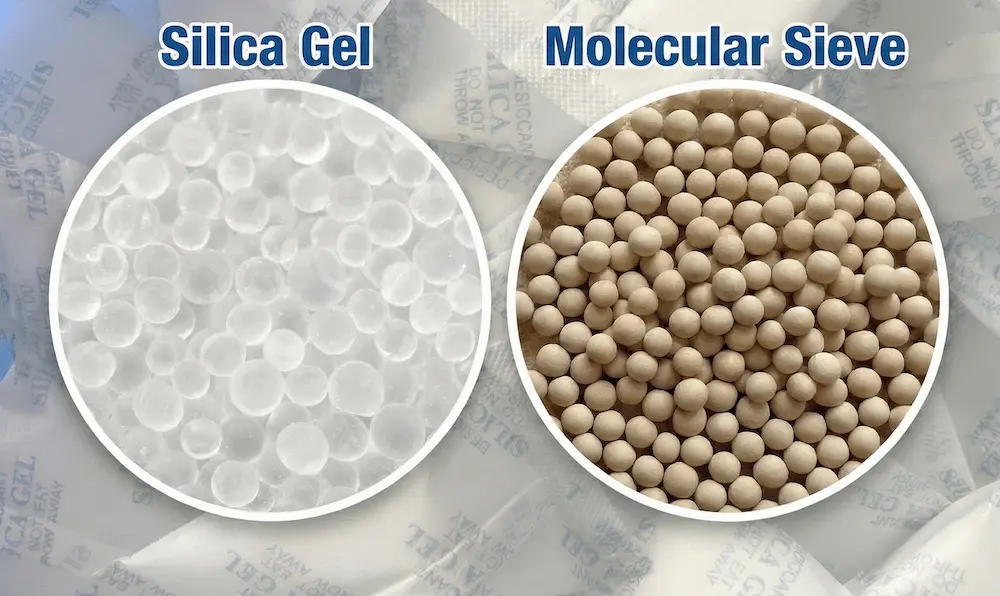
Silica Gel is Amorphous (Random). It is synthetically manufactured Silicon Dioxide (SiO2). Imagine a sponge with holes of all different sizes. It traps water randomly.
- Note: This structure doesn’t change when wet, which is why we often add Cobalt Chloride (or safer organic indicators) to make the beads change color when saturated.
Molecular Sieve is Crystalline (Uniform). It is a Zeolite or Aluminosilicate. Imagine a rigid 3D cage.
The “Sieve” Effect: This is where the Ångström (Å) measurement comes in. Manufacturers engineer the pores to be exactly 3Å (3A) or 4Å (4A) wide. This precision allows them to filter molecules—letting water in, but blocking larger molecules (like gases or solvents).
Best Use Cases
Here is how industry experts match the material to the application:
- Pharmaceuticals: Molecular Sieve
Chemical stability often requires an ultra-dry environment. Standard Silica may leave too much residual moisture.
- Food Packaging: Silica Gel
It is the industry standard. It is FDA-recognized (GRAS), non-toxic, and cost-effective for high-volume items like jerky or seaweed.
- Electronics / PCBs: Split Decision
Standard Shipping: Silica Gel is sufficient to prevent corrosion on cases and wires.
Sensitive Components: Molecular Sieves are used for sealed sensor housings or components that fail with any condensation.
- Industrial (Insulated Glass / Brakes): Molecular Sieve
In a double-paned window, any moisture creates fog. In air brakes, moisture freezes and causes failure. Zero tolerance implies Molecular Sieve.
Alternatives & Cost
Many buyers would ask what is an alternative to a molecular sieve?
If a Molecular Sieve is overkill for your budget, Silica Gel is the primary alternative. Molecular Sieves are significantly more expensive due to the precision manufacturing required to create uniform crystal lattices. You are paying for speed and low-humidity performance. If you switch to Silica Gel to save money, you must accept that your package will not get as dry, and it will take longer to get there.
Cheaper Options: For non-critical, bulk transport (like preventing cardboard from getting soggy), you can look at Montmorillonite Clay or Calcium Chloride. They are slower and messier, but cheaper.
Conclusion
Don’t guess. Use this simple framework to decide:
- Target RH: If you need <40% RH, pay for the Molecular Sieve.
- Temperature: If you expect high heat (>80°C), pay for the Molecular Sieve.
- Everything Else: If you just need general dryness at room temperature, save your money and use Silica Gel.
Still not sure? Tell us your product’s target Relative Humidity and the temperature range of your supply chain. We will calculate the exact adsorption capacity you need and recommend the correct grade.