Introduction
Moisture is the silent killer of electronics, cargo, and pharmaceuticals. Most desiccants work well, but there’s one major limitation, you cannot see whether they are still active.
That is why silica gel is divided into two main types: non-indicating (white) and indicating (color-changing).
Both absorb moisture in the same way. The difference is simple but crucial: Do you need to visually check whether the gel is saturated?
The Fundamental Difference: Visibility & Monitoring
Silica gel itself is just porous silicon dioxide. made from sodium silicate. It traps moisture inside millions of tiny internal pores. This part works the same in all variants. However, the user experience differs significantly.
Non-Indicating (White Silica Gel)
Industry operators often call this the standard or regular silica gel.
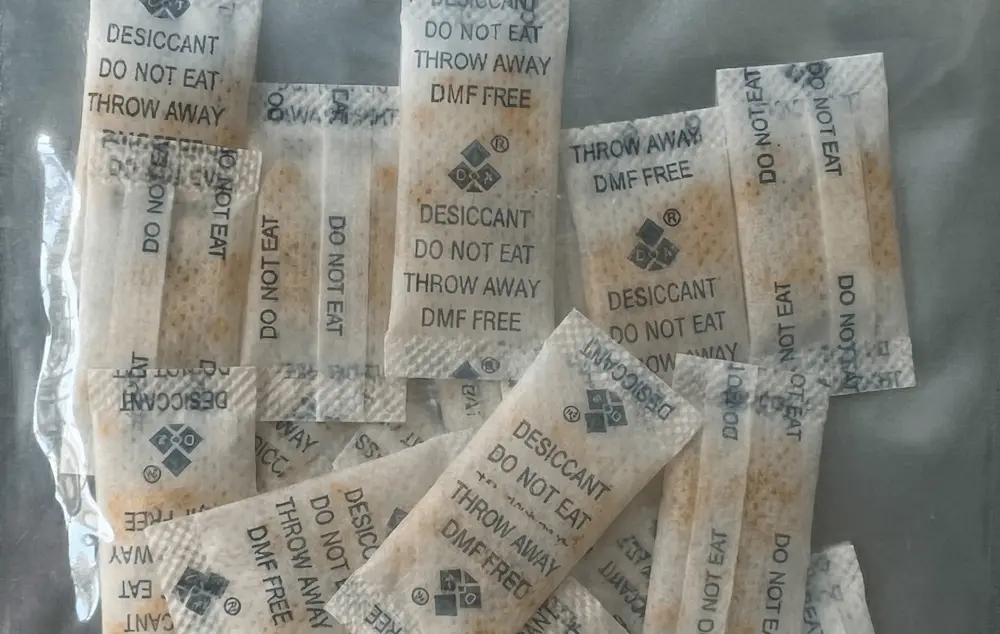
It stays white whether it’s completely dry or fully saturated. There is no visual signal. You only know it’s spent when moisture problems start appearing, or if you weigh the packet. This is the type you often see in shoe boxes, electronics packaging, medicine bottles, and export cartons.
Indicating (Color-Changing Silica Gel)
This version includes a moisture-sensitive indicator. When humidity is absorbed, the color shifts. As the beads adsorb moisture and reach their capacity, they change color (e.g., from Blue to Pink, or Orange to Green).
This allows for quick visual inspection through a sight glass or clear breather. You don’t need to open the container or weigh the beads to know if it’s time to replace them.
White vs. Blue vs. Orange: What You’re Actually Choosing Between
Choosing the right desiccant requires balancing visibility, cost, and regulatory compliance. Here is a simplified view:
Feature | White (Non-Indicating) | Blue (Indicating) | Orange (Indicating) |
Indicator | None | Cobalt Chloride | Organic dye (Methyl Violet) |
Dry Color | White | Deep Blue | Orange |
Wet Color | No Change | Pink | Dark Green / Colorless |
Toxicity | Non-Toxic | Toxic | Non-Toxic |
EU Regulation | Allowed | Banned/Restricted | Allowed |
Best Use | General packaging | Legacy industrial uses | Electronics, breathers, safe applications |
Why Blue Silica Gel Is Disappearing
For many years, Blue Silica Gel was the most common indicating type. Anyone who’s been in the industry a while has used it. But regulations have changed.
What’s the problem?
The blue color comes from Cobalt Chloride, which is now recognized as a hazardous substance and possible carcinogen. It is restricted under EU REACH. Many buyers will no longer accept it, especially for exports to Europe or industries with safety standards.
The replacement: Orange Silica Gel
Orange silica gel uses an organic dye that changes to green or colorless when saturated. No heavy metals. It is safe, eco-friendly, and compliant with global shipping regulations. This is now the go-to option for indicating desiccants.
Typical Applications
When Non-Indicating (White) Makes More Sense
- Consumer packaging: Small packets found in shoe boxes, handbag storage, and electronics boxes.
- Pharmaceuticals: Medicine bottles require the highest purity, making white silica gel the standard choice.
- One-time use packaging: Any scenario where the packet is thrown away after a single use.
When Indicating Gel Is the Better Choice
- Transformer Breathers: Essential for power utility companies to visually see when the air dryer on a transformer is saturated.
- Compressed Air Dryers: Operators can monitor dew points visually to prevent moisture from entering pneumatic lines.
- Gun Safes & Camera Gear: Protecting expensive metal and optics from rust and fungus requires constant monitoring.
- Flower Drying: Hobbyists need to know exactly when the gel is dry before reusing it.
Pro Tip: Use a 10% Indicating + 90% Non-Indicating Mix
Many factories we work with use this trick. You get scattered color indicators throughout the material and you still see when it’s saturated. Costs drop significantly compared to 100% indicating beads. This approach works especially well for bulk air-dryers, breathers, and large desiccant containers.
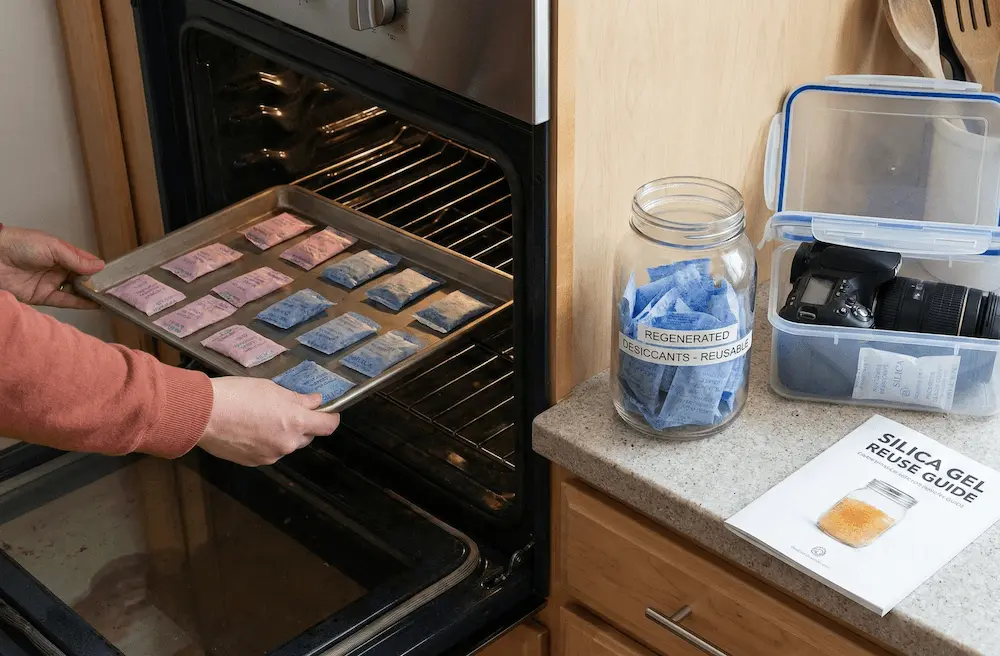
How to Reactivate/Regenerate Silica Gel Properly
One of the most useful features of silica gel is that you can reuse it. But the method matters.
Temperature guide
- White / Blue: ~120°C (250°F)
- Orange: more sensitive — keep it 100–110°C
If you overheat Orange silica gel, you will burn the organic indicator. The beads will turn black/brown and lose their color-changing ability forever, though they may still absorb moisture.
Step-by-step method
Spread the beads in a thin layer on a baking sheet. Place them in a conventional oven (fan-forced is best) for 1–2 hours. Do not use a microwave, as the rapid heating can cause the water inside the beads to expand too quickly, shattering them like popcorn.
Why Material Quality Matters More Than Most People Realize
At Desiccant Global, we insist on 100% virgin raw silica gel. We never use recycled silica gel. This isn’t a marketing line, it’s based on performance reality.
Recycled silica gel usually comes from spent desiccant that has been reprocessed. Its pore structure is partially collapsed. It will be more brittle, less absorbent, and faster to degrade after a few regeneration cycles.
Virgin silica gel performs consistently and resists fracturing, especially during reactivation. For industries that reuse gel repeatedly, this difference is significant.
Frequently Asked Questions
- Is indicating silica gel toxic?
Blue silica gel is toxic and should be handled with care. Orange silica gel and White silica gel are generally non-toxic and eco-friendly, though they should never be ingested.
- Can I mix indicating and non-indicating silica gel?
Yes. This is common and cost-efficient.
- Which is better: Blue or Orange silica gel?
Orange is the better choice for safety and environmental compliance, especially for markets like Europe. Blue is mostly used in older or non-regulated applications.
Final Thoughts: How to Choose the Right Type
It really comes down to one operational question: Do you need to visually confirm saturation or not?
Choose non-indicating, if you need a simple, low-cost moisture solution for closed packaging.
Choose indicating (orange) for critical machinery, breathers, or sensitive equipment where monitoring the saturation level is a safety requirement.
And if you want the best balance between cost and monitoring, use a 10% Orange + 90% White blend.
If you’re unsure which type fits your humidity levels, product type, or compliance needs, feel free to reach out. Our technical team can recommend a configuration based on your real operating conditions.