Industrial gas streams are unforgiving.
If you choose the wrong desiccant, you aren’t just losing drying efficiency. You’re risking shattered beads, clogged downstream valves, and an expensive, unscheduled plant shutdown.
But which one actually performs better under industrial pressure?
To give you a definitive answer, we broke down the technical specifications, adsorption isotherms, and durability metrics of both materials.
If you just want the quick takeaway, here it is:
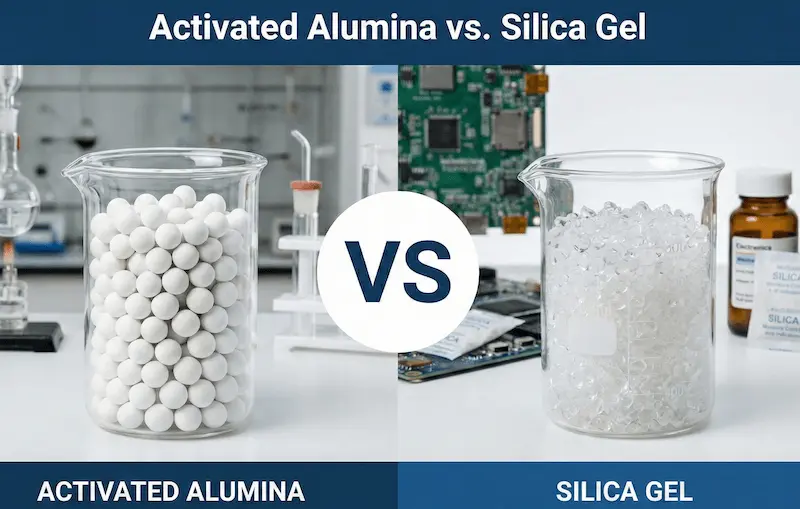
- Choose Activated Alumina if: You need deep pressure dew points (-40°F to -100°F), high crush strength, and absolute immunity to liquid water slugs in dynamic systems.
- Choose Silica Gel if: You are dealing with high relative humidity (>60%), need massive bulk moisture capacity, and your system is static or operates at lower regeneration temperatures.
Want to know the exact engineering data behind these recommendations? Here is the complete technical breakdown.
Key Physical Properties and Structure
The fundamental difference between these two materials lies in how they’re built at the microscopic level. Their pore structure determines how strong they are and how well they let gas flow through them.
Activated Alumina: Durable and Uniform
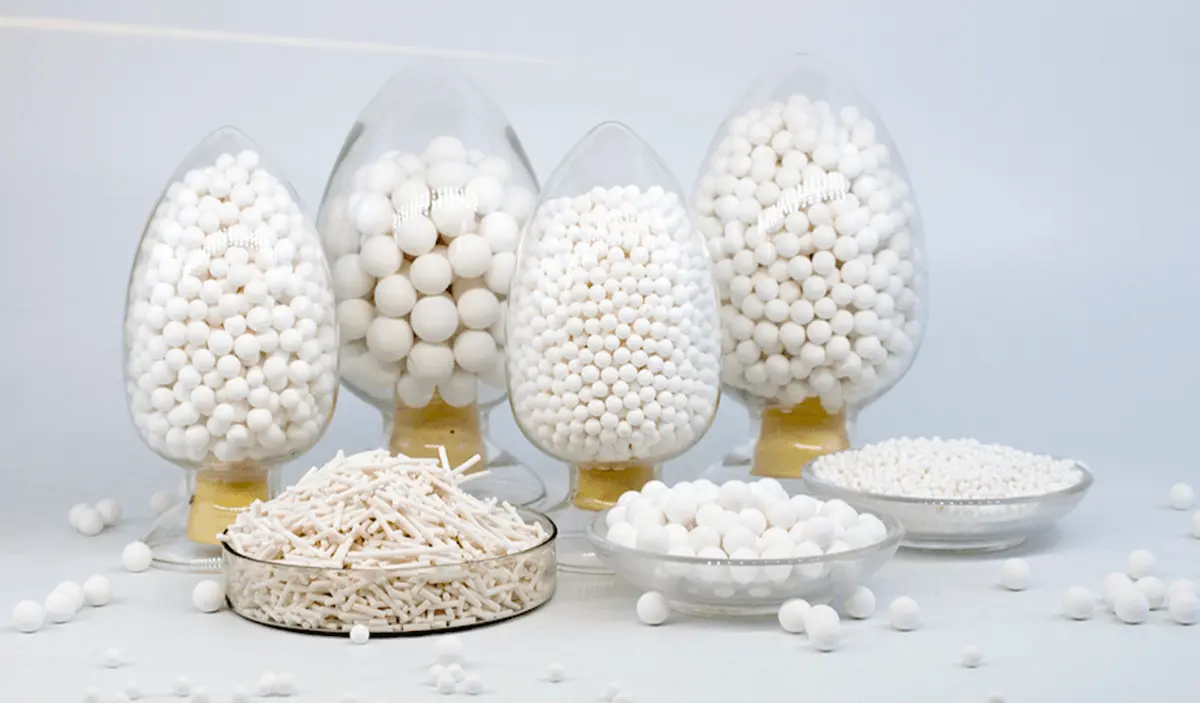
Activated alumina (Al₂O₃) is a highly porous form of aluminum oxide. It usually gives you a surface area of about 300–350 m²/g.
- Structural Strength: It has incredibly high crush strength. In high-pressure systems, this stops the beads from turning into dust, which keeps your downstream filters clean.
- Chemical Flexibility: It acts as an amphoteric ion exchanger. This just means it stays stable whether your process stream is highly acidic or highly basic.
- Smooth Flow: The beads are mostly uniform in size, which prevents gas from tunneling through weak spots in your desiccant bed.
Silica Gel: Surface Area and Reactivity
Silica gel is synthetically produced silicon dioxide(SiO₂). It’s essentially a vast network of tiny, interconnected pores.
- Surface Area: It boasts a massive surface area, usually between 600 and 800 m²/g. This is why it can hold so much moisture.
- Fragility: The skeleton of silica gel is quite brittle. It has a lower crush strength than alumina, meaning it could fracture under heavy mechanical stress.
Adsorption and Moisture Capacity
To choose the right desiccant, you need to look at your inlet stream’s relative humidity (RH) and your target outlet dew point.
When Humidity is Low (<40%)
Activated alumina might be your best choice for deep drying applications where you need extremely low dew points.
It maintains a tight grip on water molecules even when there isn’t much moisture in the air. This allows your regenerative dryers to hit pressure dew points (PDP) as low as -40°F to -100°F. Plus, its capacity stays stable even if your inlet conditions fluctuate slightly.
When Humidity is High (>60%)
Silica gel outshines alumina when you just need to remove bulk moisture from highly humid air.
At full saturation, silica gel can soak up 30–40% of its own weight in water. However, it has a weaker grip on water molecules at low vapor pressures. Because of this, it struggles to reach the extreme low dew points needed for things like instrument air.
Chemical Stability and Liquid Water Resistance
Industrial gas streams are rarely perfect. You might experience liquid water slugs or chemical contaminants, and your desiccant needs to survive these upsets.
Liquid Water Resistance
Activated alumina is virtually immune to liquid water damage. If a separator fails and water hits the bed, the alumina won’t disintegrate.
Standard silica gel, however, suffers from something called “decrepitation.” When it touches liquid water, the rapid heat of adsorption makes the beads shatter. This creates fine dust that destroys valves. While water-resistant silica exists, it usually offers much lower adsorption capacity.
Handling Harsh Chemicals
Activated alumina stays stable across a wide pH range (2–13). You can even use it to pull fluoride or sulfur compounds out of your process streams.
Silica gel is chemically unstable in highly alkaline environments (pH >9). If the pH is too high, the chemical bonds actually break down and dissolve the desiccant. It’s also highly sensitive to certain acids, according to data from chemical stability standards like those outlined by the National Institutes of Health (NIH).
Thermal Regeneration and Cycle Life
If you use heated or heatless regenerative dryers, the energy it takes to purge moisture directly impacts your operating costs.
Regenerating Activated Alumina
Activated alumina requires higher temperatures to release its water, typically between 300°F and 500°F.
However, it’s exceptionally tough under thermal cycling. It handles the stress of thousands of cycles without breaking down. In a standard compressed air setup, an activated alumina bed could easily last 3 to 5 years.
Regenerating Silica Gel
Silica gel regenerates at lower temperatures, usually around 250°F to 300°F. This might save you a little bit of energy in heated purge systems.
But be careful, if you push silica gel past 300°F, you risk permanently damaging its structure and losing capacity. Because it’s more sensitive to heat and physically weaker, it degrades faster and requires more frequent replacements.
Quick Summary Table
Feature | Activated Alumina | Silica Gel |
Primary Composition | Aluminum Oxide | Silicon Dioxide |
Surface Area | ~300–350 m²/g | 600–800 m²/g |
Max Capacity (High RH) | 15–20% by weight | 30–40% by weight |
Dew Point Capability | Excellent (-40°F to -100°F) | Good (-40°F) |
Liquid Water Durability | High (Stays intact) | Low (Shatters) |
Regeneration Temp | 300°F–500°F | 250°F–300°F |
Which Should You Choose?
When to Consider Activated Alumina
We recommend activated alumina for dynamic, heavy-duty industrial processes where reliability is your top priority.
- Compressed Air Dryers: It’s the standard for regenerative dryers needing a steady -40°F dew point.
- Natural Gas Dehydration: It easily resists degradation from liquid carryover.
- High-Temperature Streams: It works well in processes operating above 100°F where silica’s performance drops.
When to Consider Silica Gel
Silica gel might be a good fit for static applications or systems designed to remove bulk moisture at moderate temperatures.
- Static Packaging: Perfect for electronics or food packaging because of its high capacity per gram.
- Breather Vents: Tank vent dryers often use indicating silica gel because it changes color when full.
- Temperature Sensitive Goods: Great for applications where you must keep regeneration temperatures below 300°F.
Conclusion
Now I’d like to hear from you:
Which moisture issue is causing the biggest headache in your system right now?
Are you struggling to maintain a consistent -40°F dew point, or are you dealing with unexpected liquid water carryover destroying your current bed?
Let us know by leaving a comment below or contacting our engineering team directly, and we’ll help you size the right desiccant for your specific application.