Imagine having your entire container seized in Hamburg or Los Angeles. Not because your product is defective. But because of the tiny white packet thrown inside the box.
It happens more often than you think.
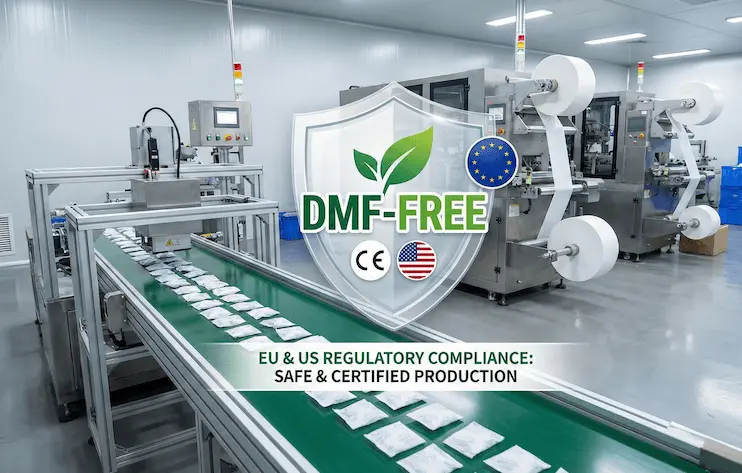
As regulations like the EU’s REACH tighten, simply keeping your product dry isn’t enough. You need to ensure your moisture protection is 100% free from toxins like Dimethyl Fumarate (DMF).
If you fail to do this, you risk costly recalls, destroyed shipments, and a damaged reputation.
The good news? Ensuring compliance is easier than it sounds, if you know what to look for.
This guide covers everything you need to know about DMF-Free Silica Gel. Including specific regulatory limits, and how to protect your supply chain.
Ready to get started?
Let’s dive in.
What is Dimethyl Fumarate (DMF)?
To understand the regulations, you first need to understand the risk.
Here is the deal:
Dimethyl Fumarate (DMF) is a potent chemical used to kill mold. Historically, manufacturers sprayed it on leather furniture or shoe boxes to survive humid ocean voyages.
It works by turning into a gas that penetrates the product.
But there is a major problem. DMF is highly toxic.
When it touches human skin, even through clothing, it can cause severe burns and respiratory issues. This became known as the “shoe dermatitis” crisis, leading to massive recalls in the late 2000s.
Because of this, the European Union passed Directive 2009/251/EC. This law strictly bans any product containing DMF in concentrations greater than 0.1 mg/kg.
Practically speaking? This is a zero-tolerance policy. If your desiccant contains detectable DMF, your entire shipment can be destroyed.
Why Use Certified DMF-Free Silica Gel?
Switching to DMF-free options isn’t just about avoiding fines. It upgrades your entire supply chain. Here are the three main benefits.
Guaranteed Customs Clearance
Using compliant packets removes a major variable from the equation. Whether you are shipping to Germany, France, or the US, compliant packets ensure you pass inspections.
No recalls. No quarantine fees. No blacklisting.
Brand Protection
Your reputation takes years to build and seconds to ruin.
By using non-toxic silica gel, you ensure that the moment a customer opens your box, they are safe. This demonstrates a concrete commitment to consumer health.
Safety Without Sacrificing Performance
There is a common misconception that you need harsh chemicals to stop mold.
The truth?
You don’t. High-quality silica gel works through adsorption. It physically traps moisture inside the bead. It keeps products dry naturally, without poisoning the fungus (or your customer).
Who Needs DMF-Free Desiccants?
Every exporter should aim for compliance. But three industries are under specific scrutiny:
- Leather & Textiles
Leather is porous and prone to mold. Customs officials frequently target shoe, furniture, and apparel shipments for random DMF testing.
- Pharmaceuticals & Food
These sectors operate under strict FDA and EFSA standards. Desiccants here must be non-toxic and food-contact safe.
- Electronics
Volatile chemicals like DMF can off-gas and corrode sensitive circuit boards. Pure silica gel provides protection without contamination.
How to Verify Your Desiccant Supplier?
In our experience, many suppliers claim to be DMF-Free.
But talk is cheap.
Here is exactly how to verify quality before you place an order:
Step #1: Check the Certifications
Don’t just ask “Is it safe?” Ask for the documents. A reputable supplier should immediately provide REACH compliance documents and RoHS reports.
Step #2: Demand Third-Party Lab Testing
Request a recent test report from an accredited lab (like SGS, TUV, or Intertek).
Look specifically for the “Dimethyl Fumarate” line item. The result must be “N.D.” (Not Detected).
Step #3: Look at the Packaging Quality
Quality usually travels together.
Is the desiccant packaged in high-grade Tyvek? Is the ink clear and non-smudging?
If the packet looks cheap or dusty, it indicates the manufacturer likely cuts corners on the inside, too.
FAQs about DMF Compliance
What is the difference between standard and DMF-free silica gel?
Chemically, pure silica gel is naturally DMF-free. However, the “DMF-Free” label guarantees the manufacturer has strict controls to prevent cross-contamination during production.
Is it mandatory for Europe?
Yes. Under EU REACH regulations, any article containing DMF above 0.1 mg/kg is effectively banned.
Can I tell if my desiccant has DMF by smell?
You cannot verify this by smell or sight. DMF can be odorless in low concentrations. The only way to be 100% sure is to request a Material Safety Data Sheet (MSDS) or a recent SGS test report from your supplier.
Is DMF-free silica gel safe for food packaging?
No. DMF can be odorless in low concentrations. You must request a lab test (MSDS or SGS report) to be 100% sure.
Compliance Is An Ongoing Process
It’s easy to overlook desiccants as a minor detail. But as we’ve seen, compliance isn’t just a “nice-to-have.” It is the difference between a successful delivery and a customs nightmare.
It might feel tedious to demand fresh SGS reports from your supplier every quarter. Or to pay a fraction of a cent more for high-grade Tyvek packaging.
But consider the alternative.
Don’t let a 5-gram packet sink a 5-ton shipment.
Focus on building a relationship with a supplier who values safety as much as you do. The peace of mind is worth every penny.
Does your current supplier provide up-to-date REACH documentation?
Let me know by sending a quick inquiry or checking your latest test report.