Do You Have to Use Tyvek?
When we work with procurement managers and packaging engineers on desiccant sourcing, one question comes up again and again: Is Tyvek® mandatory for desiccant packaging?
The short answer is no. There is no FDA rule that forces you to use a specific brand name.
The practical answer, based on real audits, stability testing, and field failures, is more nuanced. For direct-contact food and pharmaceutical applications, the material properties that Tyvek provides are so critical that it has become the industry default.
In our experience, most alternative materials fail for one of three reasons:
- They shed fibers during vibration or handling
- They lose strength when exposed to moisture
- They struggle to pass compliance reviews without additional justification
Tyvek consistently avoids these issues, which is why it is often viewed as the “safe choice” when regulatory risk matters.
Regulatory Compliance: Understanding "Food Contact" Status
To understand why Tyvek is preferred, it helps to look at the regulation that actually governs desiccant packaging materials.
FDA 21 CFR 177.1520
The key regulation for desiccant packet materials is FDA 21 CFR 177.1520, which covers olefin polymers, including High-Density Polyethylene (HDPE).
Tyvek® is manufactured from 100% HDPE continuous filaments. That matters because the packet material must meet strict extraction limits, satisfy density and composition requirements and contain no harmful plasticizers or additives that could migrate.
When a Tyvek packet meets 21 CFR 177.1520, it provides assurance that nothing harmful can leach from the packet into food or drug products, even under humid or long-term storage conditions.
Direct vs. Indirect Food Contact
Not all desiccant applications are treated the same under FDA scrutiny. Understanding this distinction is critical.
Direct Contact
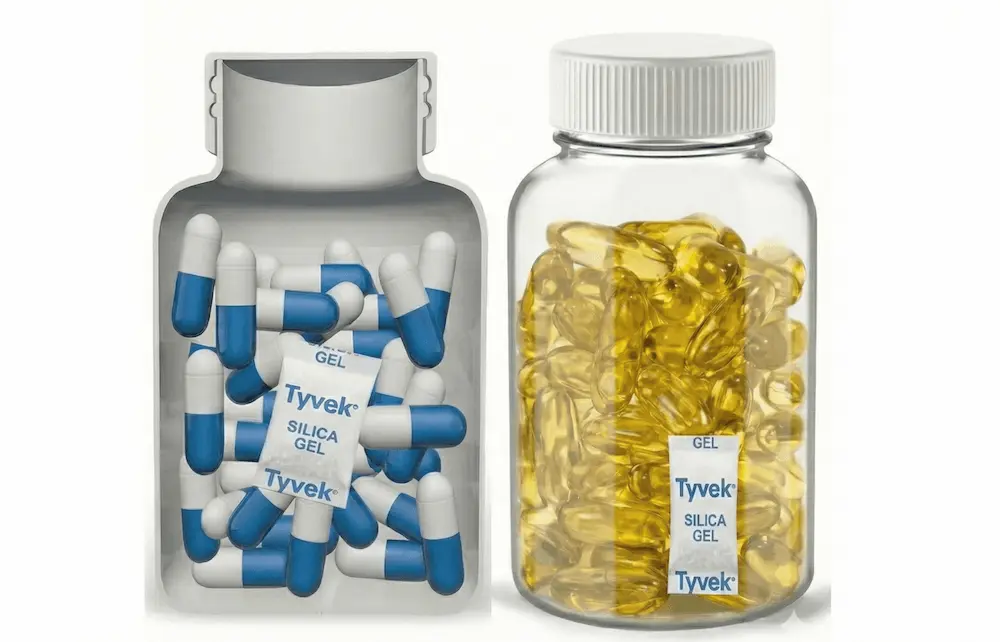
This is when the desiccant packet physically touches the product (e.g., a packet inside a pill bottle or a beef jerky).
For these cases, Tyvek is effectively essential. Its chemical inertness and clean structure minimize contamination risk, even when humidity is high.
Indirect Contact
Indirect contact refers to desiccants placed in secondary packaging, such as shoe boxes, electronics cartons, outer shipping cases.
Here, requirements are less strict. That said, many pharmaceutical brands still specify Tyvek even for indirect contact, simply to eliminate any chance of dusting or accidental exposure during transit.
Letters of Assurance & GRAS
One of the most common mistakes we see is assuming compliance based on appearance.
Always ask your supplier for a “Letter of Assurance” or a Compliance Declaration. This document confirms that the Tyvek material specifically meets 21 CFR standards.
Compliance is two-part. The content must be GRAS (Generally Recognized As Safe), while the packet material must be FDA-compliant. If either part fails, the system, fails.
Why Tyvek is the Standard: Material Science & Function
While regulatory compliance is the baseline, the physical performance of the material is what actually protects your product.
Breathability vs. Barrier
A desiccant packet must do two opposite things, allow moisture vapor in, and keep desiccant dust and liquid out.
Tyvek® is made of spun-bonded HDPE fibers that create a tortuous path structure. This unique structure is semi-permeable.
It allows water vapor to pass through the material freely so the silica gel or clay can absorb humidity. However, liquid water and solid particles are blocked. Unlike paper, Tyvek does not act like a sponge. This is especially important when dealing with high-humidity environments or aggressive moisture absorbers.
Non-Linting Properties
In pharmaceutical packaging, lint is considered foreign contamination.
Paper and low-grade non-wovens are made from short fibers. During vibration, inside a pill bottle, those fibers can shed.
Tyvek is different. Its continuous HDPE filaments are thermally bonded, leaving no loose fibers to break free. This non-linting behavior is one of the main reasons Tyvek passes particulate inspections that paper often fails.
High Wet Strength
Standard paper packets lose their structural integrity when wet. If a paper packet absorbs too much moisture, it becomes soggy and can easily tear, spilling the desiccant beads into your product.
Tyvek retains its tensile strength and tear resistance even when saturated, significantly reducing burst risk during long-term storage.
Sterilization Compatibility for Medical Devices
When desiccants are used inside medical device packaging, they often go through the same sterilization process as the device itself.
Gamma Irradiation
Gamma radiation is a common method for sterilizing medical devices.
Tyvek is compatible up to typical industry doses (≈50 kGy). It maintains its tensile strength and barrier properties, and does not become brittle or discolor.
Ethylene Oxide
EtO is a gas sterilization method used for heat-sensitive devices.
It is highly compatible due to Tyvek’s breathability. This allows rapid penetration and off-gassing, leaving minimal residue risk.
Steam Autoclave
Standard Tyvek grades can deform under high-temperature steam.
If steam sterilization is required, always consult your supplier for high-temperature–rated grades or alternative solutions. In most cases, Tyvek is best suited for low-temperature sterilization methods such as EtO, Gamma, or Plasma.
ISO 11607 and Medical Device Packaging
For medical device manufacturers, regulatory adherence goes beyond the FDA. You must also consider ISO 11607.
ISO 11607 requires packaging materials to provide physical protection, maintain sterility, and allow aseptic opening without shedding particles.
Because Tyvek does not lint or fragment when handled, it helps manufacturers meet strict particulate matter limits. In contrast, paper packets can cause failures during validation testing.
Labeling, Printing & Ink Safety
Compliance isn’t just about the white fabric; it’s also about the print.
Warnings printed on desiccant packets must use FDA-compliant, food-grade inks.
Inks must be tested to ensure they do not bleed or leach onto the product, even if the packet becomes damp.
When requesting compliance documentation, ensure your supplier’s Letter of Assurance also covers the ink system, not just the base material.
Tyvek vs. Alternatives: When Can You Use Paper?
Not every application needs the highest-grade material. The key is understanding risk. Below is a quick comparison to help you decide when to invest in Tyvek and when standard paper might suffice.
Feature | Tyvek® (Spun-bonded HDPE) | Coated Paper / Kraft |
Durability | High. Tear-proof and puncture-resistant. | Low, especially when wet. |
Linting | None. | Moderate fiber shedding. |
Wet Strength | Excellent. | Poor. |
FDA Status | Direct food & drug contact | Indirect contact only |
Sterilization | Gamma & EtO compatible | Limited |
Best Use Case | Pharma, medical, wet food | Shoe boxes, electronics, dry goods |
FAQs on Common Compliance Questions
What FDA regulation applies to Tyvek desiccant packaging?
Tyvek is made from 100% HDPE, which falls under FDA 21 CFR 177.1520 for olefin polymers used in food contact applications.
Can I use paper desiccant packets for pharmaceuticals?
For direct contact, it is generally not recommended due to linting and burst risk. Tyvek is the industry standard.
Is Tyvek breathable?
Yes. It allows moisture vapor to pass while blocking liquid water and particles.
Does Tyvek desiccant packaging meet European standards?
Medical-grade Tyvek typically complies with the European Pharmacopoeia and EU Regulation No. 10/2011. Always confirm specific grades with your supplier.
Conclusion
You are not legally required to use the Tyvek® brand by name. However, for direct-contact food, pharmaceutical, and medical device applications, the combination of regulatory compliance, non-linting behavior, wet strength, and sterilization compatibility makes Tyvek the most reliable option.
In practice, it reduces audit risk, minimizes failure points, and simplifies compliance reviews.
If you need documentation support or want to evaluate performance firsthand, our engineering team can provide FDA compliance declarations or samples for stability testing.